


On Dec. 15 2025, Ken Liu, New York Times best-selling author, spoke to a wide swath of San Francisco’s Y Combinator entrepreneurs and Asian American community, offering a deep, philosophical meditation on the origins of his latest AI-driven sci-fi, All That We See and Seem. A Harvard graduate in both computer science and English literature, and later a Harvard-trained lawyer, Liu embodies a rare synthesis of disciplines. Since becoming a writer in 2017, he has also translated The Three Body Problem, which premiered on Netflix in 2024. His command of both technological fluency and literary imagination is unmistakable in the way he unpacks the metaphors, historical echoes, and character architectures animating the novel. Liu also describes his creative process, which includes visiting technology labs to understand the in-person mechanics behind the science he depicts, an approach that grounds his speculative worlds in lived, tactile experience.
In the video below, Liu turns particular attention to two central figures in his story: Julia, a renowned hacker and embodiment of justice, and Elli, a virtual dream-artist kidnapped by criminals. Their intertwined stories reflect the “deeply pessimistic political climate” of the present, an era in which many feel estranged from the American dream, or fear that the dream no longer has a place for them. Elli and Julia’s complicated relationship with that dream is, in his words, “emblematic of this moment today.” The American dream itself becomes an “incredibly powerful metaphor,” a “background reality,” a “background heartbeat” pulsing beneath everything from Silicon Valley’s innovation corridors to the quiet stretches of rural Pennsylvania.
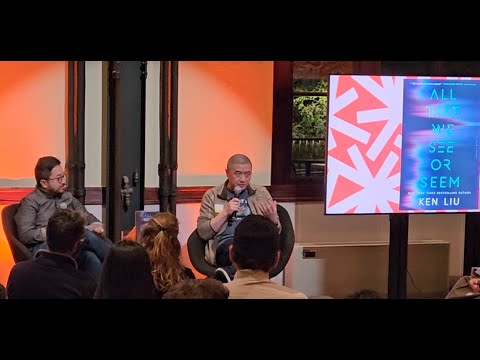
Liu’s discussion broadens to the American dream itself, noting that many of its most enduring definitions were articulated by outsiders such as Alexis de Tocqueville. Writing in the 1830s, nearly two centuries ago, Tocqueville’s observations are deeply relevant today: Americans possess a deep desire to “collectively erase the past, belong together in the present,” and build “the future together.” In the current political climate, questions of belonging, identity, and national purpose continue to resurface. The tension Tocqueville identified between reinvention, community, and the future feels unresolved yet deeply crucial: “The dream is the background heartbeat to all of us.”
In a fitting convergence of life and art, we spoke with two cofounders at the event who embody that very pursuit of possibility. Y Combinator is the world’s leading start-up accelerator, funding early stage companies with $500,000 investments and three-month intense mentorships with access to its powerful alumni network. It has funded over 5,000 companies whose combined valuation exceeds $800 billion. Both Yale graduates, they left their roles at Amazon to build an AI startup of their own. Like many smart and hungry minds wading into San Francisco’s tech waters, Nessie cofounders Anna Zhang and Tiger Wang seized their chance at the American dream and recently completed the Y Combinator program. The pair first met in a “discrete math” class at Yale and are now using unstructured data, such as AI chats, to help innovators and founders build a personalized AI super brain, a kind of cognitive “mini-me,” for intelligent rapport. Y Combinator, they shared, was a “life-changing experience … it propelled us from being engineers to founders.”