


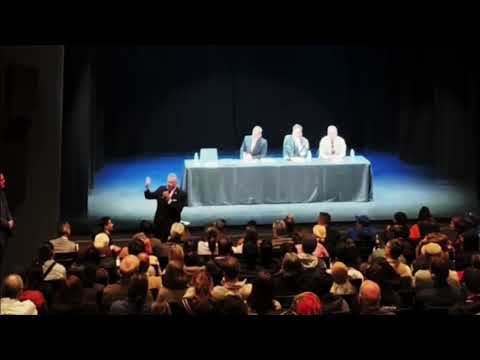
Residents and stakeholders of San Francisco’s South of Market got answers to long-standing neighborhood safety issues from Mayor Daniel Lurie, Supervisor Matt Dorsey, and other city officials at a town hall meeting held Monday evening at the Strand Theater on Market Street. Police Chief Paul Yep and Sheriff Paul Miyamoto were also on hand to talk to the crowd.
“I don’t think the city does a good job of measuring who comes to San Francisco mainly to engage in drug-related behavior”
Supervisor Matt Dorsey
In Lurie’s opening remarks, he recognized there is still a lot of work ahead. He validated that sentiment by sharing that he often gets multiple calls every morning before 8:30 a.m. from Mark Mazza, Tenderloin streets operations manager under the Department of Emergency Management.
He also provided a brief explanation for being a hair late to the Town Hall: He stopped to talk to a homeless person he’s familiar with who was blocking traffic at the intersection of Market and Octavia streets. He concluded his opening remarks by sharing that he walked the corridor of Third St and SFMOMA today and claimed the streets in the area were cleaner than he’s seen in a long time.
The hour-plus-long town hall mainly consisted of residents and representatives from the SOMA West Community Benefit District, South Beach, Rincon Hill, Mission Bay Associations, and the Mid-Market Business Association asking questions. Dorsey and Lurie, along with Interim Chief Paul Yep and Sheriff Paul Miyamoto, were the panelists. Lurie deferred to Kunal Modi, his human services policy chief, a few times to address more specifics to questions from the audience.
Before the Q. & A. started, Dorsey asked Interim Chief Yep to address the attendees with an update relating to the shooting that occurred early Sunday morning at the intersection of Sixth and Natoma streets. Interim Chief Yep acknowledged SFPD had arrested Derral Robi, 48, on suspicion of murder and being a felon in possession of a firearm, Monday afternoon at the intersection of Market and Jones streets.
Questions and comments covered a wide gamut of topics, from concerns about Southern Station police staffing to the feeling of a broken culture within SFPD to the over-concentration of supportive housing, shelters, and other services in South of Market, and the newly announced sobering center to be located at 444 Sixth Street.
Alice Rogers cited concerns about staffing shortages and delayed SFPD response times. Interim Chief Yep noted (with help from Southern Station Captain Hurwitz in the audience) that there are currently 68 patrol officers at Southern Station today. Lurie and Yep repeatedly claimed they’ll be more deliberate in the coming months to increase staffing at Southern Station. They recognized in recent years that it has taken 27 months to graduate from the Police Academy. That process is down to 11 months, and they intend to shorten the time to complete the academy to six months, with continued training for newly hired officers during their first months on the beat.
Alex Ludlum, executive director of SOMA West CBD, alleged that the culture within SFPD is broken, citing two recent calls to police for various crimes that ended with the release of both potential suspects and no arrests. Ludlum also referenced the need to hire private security through SOMA West CBD due to a lack of police presence in West SOMA.
Lurie and Yep addressed the question separately. Lurie refuted the claim, stating, “I don’t think the culture is broken.…We will investigate those two incidents.” Yep responded, “It is changing,” that a message of “back to the basics” is going out to the rank and file.
Another attendee expressed positive sentiment about the new sobering center slated to open at 444 Sixth Street early next year. However, they asked for clarity on which metrics will be used to determine the sobering center’s success.
Before handing the mic to Kunal Modi, Dorsey shared that he was proud of the innovative approach Lurie and city partners were taking with the new sobering center — though he admitted the process was a bit rushed and lacked community input.
A few angry voices briefly interrupted the program. One male shouting repeatedly, “Terrible idea.”
Modi shared the following three accountability metrics to be implemented when the center opens: the number of public drug use arrests in each intervention; conversions to treatment or relocation to “that next step”; and officer turnaround time.
Sheriff Miyamoto clarified that the sobering center is intended to fill the gap between jail and the emergency room. He cited that jails are at capacity, and emergency room visits take hours away from officers instead of being out on the street.
There are still a few questions about the sobering center, including who will run it. Modi stated they are looking at out-of-state options, hinting he has moved on from any current city contractors.
One attendee asked about the over-concentration of permanent supportive housing and shelters in District 6 and asked what the city was going to do about the current reality moving forward. Modi sided with the unknown attendee by stating he “agrees with the premise.”
Modi and Lurie also noted they take into consideration things such as Bilal Mahmood’s recent legislation promoting equitable access to shelter and services by prohibiting the city from siting certain facilities where a neighborhood’s share of shelter and transitional housing beds exceeds its share of unsheltered persons when identifying new sites.
Throughout the evening, Dorsey hinted at a ballot measure and a few pieces of legislation he’s working on to continue combating the drug and homelessness crisis, including a drug-free sidewalk ordinance that will be on the June (special election) ballot. The city attorney is currently reviewing the ordinance.
Other legislation will require specific departments to define the criteria for San Francisco residency, such as requiring General Assistance applicants to claim residency within 15 days. “I don’t think the city does a good job of measuring who comes to San Francisco mainly to engage in drug-related behavior,” Dorsey told the audience. Another bill will expand drug-free recovery housing options in permanent supportive housing.
The reaction was mixed. “More of the same,” stated one attendee (who chose to stay anonymous) after the meeting had wrapped up. But some left with renewed optimism that Mayor Lurie and his partners are taking the city in the right direction in combating public safety and the drug crisis plaguing their neighborhoods.